
What You Apply on Skin Enters Your Blood: Truth or Myth? (The Science Explained)
If you love your AM and PM routine and recently heard someone say that all of your skincare products penetrate inside your skin, this blog is for you.
Every time you rub your favourite face moisturizer or dab a vitamin C serum on your face, you must’ve wondered if it all goes into your bloodstream.
The claim of “60% skincare penetrating your skin” is ragebait and yet it circulates everywhere - WhatsApp forwards, Instagram reels, wellness influencers.
But how much of it is actually true?
Let’s answer your question with some cool science.
How Does Your Skin Actually Work?
Your skin is not a sponge. It is, in fact, one of the body’s most effective protective barriers.
The outermost layer of the skin is called the stratum corneum which is made up of tightly packed dead skin cells, surrounded by lipids such as ceramides, cholesterol, and fatty acids.
Your skin’s primary role is to prevent excessive water loss while protecting the body from external microbes, irritants, and chemicals.
Beneath the stratum corneum lies the rest of the epidermis, followed by the deeper dermis where blood vessels are located.
For your lotion to get absorbed into the bloodstream, it’ll have to pass multiple layers of skin and penetrate deeply.
Most skincare products don’t have the formulation to penetrate this deeply.
In reality, many ingredients from your skincare remain primarily within the upper layers of the skin, where they perform their intended function.
Only certain types of molecules that are very small, lipid-soluble, or specifically designed for transdermal delivery, such as nicotine or hormone patches - can penetrate the skin barrier efficiently enough to reach your bloodstream.
The Myth About "60% Absorption”:
You must’ve seen this myth making the rounds on the Internet: "60% of what you put on your skin is absorbed into your bloodstream."
Health influencers will fear-monger you with total confidence, often in the same tone as they sell a "detox" product.
This stat is not backed by science!
No peer-reviewed study claims that 60% of your skincare enters the bloodstream.
The myth likely comes from older studies on transdermal drug delivery and occupational chemical exposure, where specific substances were designed or able to penetrate the skin barrier.
Read More: The Science Behind Antioxidants: How They Protect Your Body
But this does not mean your skin care products are being absorbed directly into your blood in the same way.
If you feel a ‘sinking-in’ sensation after applying a moisturiser, it does not necessarily mean the product has entered your bloodstream.
Often, water and volatile components evaporate while other ingredients remain within the upper layers of the skin.
Skin Penetration vs. Skin Absorption - There's a Big Difference:
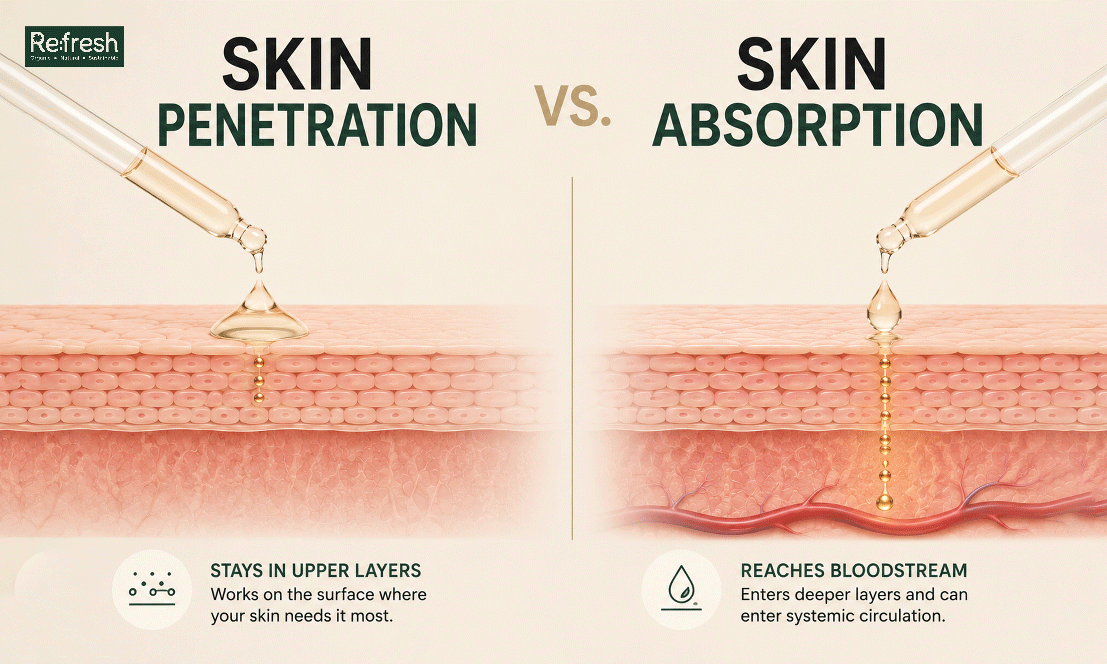
Most people miss the skin penetration myth and it’s the reason the entire “skin absorption myth” became so confusing online.
When people ask, ‘Does skin absorb chemicals?’ or ‘Does lotion get absorbed into the bloodstream?’, they’re often mixing up two very different scientific processes: skin penetration and transdermal absorption.
Skin penetration simply means a substance has moved through the stratum corneum (the outermost layer of the skin) and reached the upper layers of the epidermis.
This is how your moisturiser for dry skin, face moisturizer, eye cream, and even vitamin C serum for face is designed to stay within these outer skin layers to hydrate, brighten, protect, or reduce water loss.
Transdermal absorption is very different because it means a molecule has traveled through all skin layers, entered the dermis, and reached the bloodstream through systemic circulation.
Only certain small, lipid-soluble molecules or specially formulated medications like nicotine patches - can do this efficiently.
In other words, most skincare ingredients absorbed through skin are not entering your blood in significant amounts.
Whether it’s a cream moisturizer, best face serum, cream for dark circles, or other skin care products, they are primarily formulated to act locally on the skin — exactly where they are needed.
What Actually Gets Absorbed?
Some substances can pass through the skin deeply enough to enter the bloodstream, especially:
- Small, fat-soluble ingredients: these move through the skin barrier more easily than larger molecules.
- Certain medicines: ingredients like nicotine, estrogen, and diclofenac are specially designed to pass through the skin using patches or medicated gels.
- Some sunscreen ingredients: A 2019 study published in JAMA found that a few sunscreen chemicals, including oxybenzone, could be detected in the blood after repeated heavy use. However, the study did not conclude that these ingredients were harmful - only that more research was needed.
What Does NOT Enter the Bloodstream
A vast majority of standard skincare cannot cross your skin barrier:
- Hyaluronic acid - The molecule is too large to penetrate beyond the surface; it works by sitting on skin and drawing in moisture
- Niacinamide - Works primarily at the epidermis level
- Most plant-based ingredients in your best moisturizer for glowing skin - Their large molecular structures prevent them from going deep
Here’s Why You Should Choose Cleaner Skincare Ingredients:
Regardless of whether a chemical will reach your bloodstream, long-term, repeated exposure to certain ingredients is still an area researchers continue to study.
Parabens, sulfates, artificial fragrances, and chemical sunscreens may not accumulate instantly - but applying them morning and night, 365 days a year, is still worth thinking about.
This is especially relevant in hot and humid climates like India, where sweating, increased oil production, and a compromised skin barrier may make skin more reactive or sensitive.
Switching to products formulated with natural, plant-derived ingredients isn’t about fear - but about trusting nature for your skin.
A paraben-free moisturizer for oily skin like this one from the soil concept does the same job without relying on certain synthetic additives.
A vitamin C serum for the face derived from real plant sources (like amla, or Indian gooseberry) works in harmony with your skin's biology.
If you're ready to make that switch, Refreshyourlife stocks a curated range of paraben-free beauty products - from natural bodywashes to face moisturizers and serums — all verified so you don't have to spend hours decoding ingredient labels.
The Bottom Line:
The idea that common skincare products like lotion enter your bloodstream in large amounts is largely a myth.
But that doesn’t mean harmful chemicals won’t penetrate your skin.
Your skin is a remarkable barrier, and most of what you apply remains within the outer layers of the skin.
However, some molecules can penetrate deeper over time, and daily cumulative exposure is a real conversation worth having.
The smartest approach? Choose skincare made with clean, plant-based ingredients - not because of fear, but because your skin deserves better.
If you're looking to make a thoughtful shift toward cleaner beauty, explore Refreshyourlife’s range of certified organic personal care products - where ingredients are selected more thoughtfully.
Frequently Asked Questions:
-

You're Probably Storing These 10 Everyday Foods the Wrong Way
August 19th, 2026 -
 August 17th, 2026
 -

Organic vs Regular Spices: Are Organic Spices Really Better?
August 14th, 2026 -

What Did Lord Krishna Really Eat? 7 Favorite Foods for Janmashtami
August 12th, 2026 -
 August 10th, 2026