Organic vs Chemical Fertilizers in India: Complete Guide to Benefits, Risks & Best Choice (2025)
In India, a massive amount of roughly 600 million tonnes (LMT) of fertilizer is used annually to feed the ever-growing population. (1)
Fertilizers are deeply connected to food safety, public health, water quality, farmers’ wellbeing, and the future of sustainable agriculture.
As health awareness grows, Indians are concerned about contaminated water, soil degradation, and declining food quality.
The debate between organic fertilizers and chemical fertilizers has become more relevant than ever.
India is the world’s second-largest consumer of chemical fertilizers, and we’ve supported food production, but we’ve also brought environmental and health challenges.
In this blog, we are comparing organic fertilizer vs. chemical fertilizer to understand how fertilizers affect not just crops, but also our bodies, our environment, and our long-term well-being.
What Is Organic Fertilizer?
In India, organic fertilizers include organic compost, farmyard manure, vermicompost, green manure, neem cake, bone meal, and biofertilizers.
Organic fertilizers improve soil health and allow soil microorganisms to slowly release nutrients to the plants.
The use of organic manure has grown exponentially with the rising demand for organic foods and products.
India produces nearly 1.8 billion tonnes of manure annually, which, if managed well, can significantly reduce chemical fertilizer dependence (ICAR).
Organic fertilizers can help improve soil fertility and help retain moisture, which is useful for India’s drought-prone and climate-vulnerable regions.
What Is Chemical Fertilizer?
Conventional chemical fertilizers such as Urea, MOP, SSP, DAP, and NPK blends are widely used in Indian agriculture to increase yield.
India is one of the world’s largest producers and consumers of urea, and nearly 60–65% of nitrogen fertilizer used in India is subsidized (Department of Fertilizers, Government of India). (1)
These fertilizers have provided fast nutrient availability and deliver a high yield, especially for a large population.
However, excessive and long-term chemical fertilizer use in India has led to serious environmental problems.
According to the ICAR, over-dependence on nitrogen fertilizers has damaged soil health in several states, including Punjab, Haryana, and Uttar Pradesh.
Indian soil has been losing its organic carbon content and microbial diversity due to excessive use of chemical fertilizers, which affects nutrient value and long-term productivity.
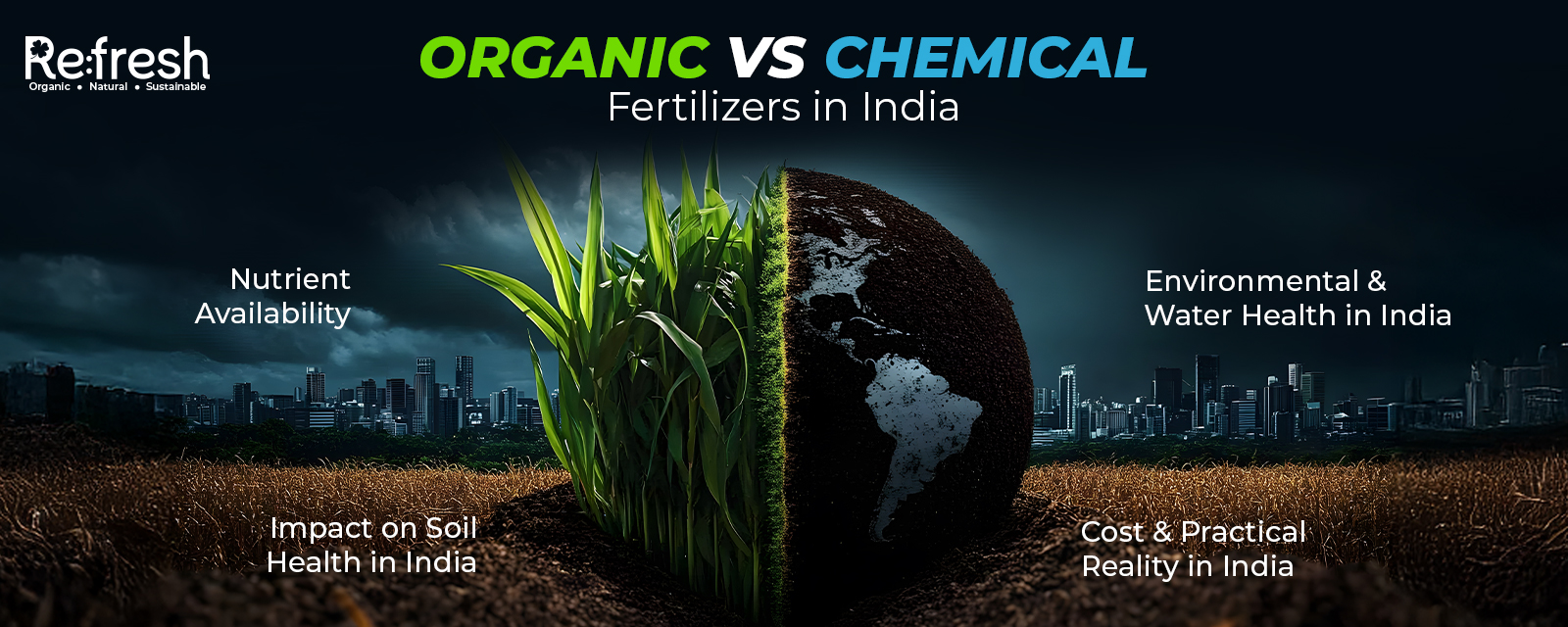
Organic vs Chemical Fertilizers in India:
-
Nutrient Availability:
Organic fertilizers release nutrients steadily through slow-paced biological processes. Natural fertilizers prevent overfeeding and overfeeding of nutrients to the crops.
Meanwhile, chemical fertilizers dissolve immediately and give instant results, which is why Indian farmers prefer them for fast-growing crops.
But fast growth does not always mean sustainable or healthy soil.
-
Impact on Soil Health in India:
An ICAR report warns that around 40% of Indian soil is showing signs of nutrient imbalance due to excessive fertilizer use.
Continuous chemical and pesticide use without any organic input will reduce the organic carbon, leading to hardening of the soil and reduced microbial life.
On the other hand, organic fertilizers tend to improve soil texture, increase organic diversity, and encourage beneficial biodiversity.
Healthier soil often means more stable nutrition in crops and resilience.
-
Environmental & Water Health in India:
India faces major groundwater and water pollution issues due to fertilizer runoff.
Continuous chemical and pesticide use without any organic input will reduce the organic carbon, leading to hardening of the soil and reduced microbial life.
- Nearly 30% of India’s groundwater blocks are nitrate-contaminated, much of it linked to fertilizer misuse (Central Ground Water Board – CGWB).
- High nitrate levels in drinking water are linked to serious diseases like “blue baby syndrome” and potential cancer risks.
- The Ministry of Health and WHO warn that nitrate-heavy water is unsafe, especially for infants and pregnant women.
- States like Punjab, Haryana, Rajasthan, and parts of Uttar Pradesh frequently report nitrate contamination.
Chemical fertilizer runoff also contributes to water pollution and marine life loss in water reservoirs.
Organic fertilizers pose a far lesser risk of chemical leaching if used efficiently and regulated well.
-
Cost & Practical Reality in India:
Chemical fertilizers are heavily subsidized in India, making them cheap and widevly accessible. Organic fertilizers require effort, composting, and time.
However, long-term dependency on chemical fertilizers increases soil rehabilitation costs, reduces fertility, and burdens farmers economically.
Organic fertilizers improve soil over time, reducing the cost burden in the long run.
Read More: Why does Organic food cost more than regular foods?
Health & Nutritional Benefits of Organic Fertilizer:
Healthy soil supports healthier crops, and healthy crops are the base of healthy nutrition that supports human health at its core.
When soil health declines, the nutrient availability of plants also declines, which will lead to low nutrients on our plates.
How Organic Farming Helps Health in India:
- Reduces the exposure of harmful chemical residues in food and the environment
- Enhances soil health, which lead a nutrient-rich food on our plate.
- Promotes a safer and more sustainable microbial diversity.
- Prevents water contamination and supports cleaner drinking water and food safety
Sikkim has become 100% organic, and many regions in Andhra Pradesh are adopting Natural Farming, showing positive outcomes for the environment, farmers, and public health.
This makes responsible fertilizer use a health issue, not just an agricultural one.
| Feature | Organic Fertilizer | Chemical Fertilizer |
|---|---|---|
| Availability | Farm waste, compost, biofertilizers | Easily available, government subsidized |
| Impact on Soil | Improves soil life & structure | Can degrade soil if overused |
| Water Impact | Low chemical contamination risk | Major cause of nitrate pollution |
| Food Safety | Supports safer food systems | Water contamination health risks |
| Cost | Long-term savings | Cheap initially, costly long-term |
| Best Use | Sustainable & health-focused farming | Immediate yield boosting |
Conclusion
In India, organic fertilizer will help maintain overall health, the environment, sustainability, and the future of safe food.
Where chemical fertilizers provide high yield but harm soil, organic fertilizers nurture life in soil and support safer ecosystems.
Healthy soil grows healthy crops. Healthy crops nourish healthy Indians.
When India takes care of its soil, India takes care of its people.
FAQs
-
What are the advantages of organic fertilizers in India?
They improve soil fertility, support sustainability, reduce pollution risk, and support safer food.
-
What are the disadvantages?
They work slowly, require composting and patience.
-
What are the disadvantages of chemical fertilizers?
Water pollution, soil damage, and nitrate contamination risks.
-
Which is better: NPK or DAP in India?
DAP is useful for phosphorus requirements. NPK is best for balanced nutrition. Always depend on soil testing.
Explore More From Naturopedia
15 Ways to Save Money on Organic Food
-

You're Probably Storing These 10 Everyday Foods the Wrong Way
August 19th, 2026 -
 August 17th, 2026
 -

Organic vs Regular Spices: Are Organic Spices Really Better?
August 14th, 2026 -

What Did Lord Krishna Really Eat? 7 Favorite Foods for Janmashtami
August 12th, 2026 -
 August 10th, 2026